Wheel Throwing
Wheel Throwing for Beginners: Your First Steps on the Potter's Wheel
Honest advice about centering clay, managing expectations, and actually enjoying the learning curve
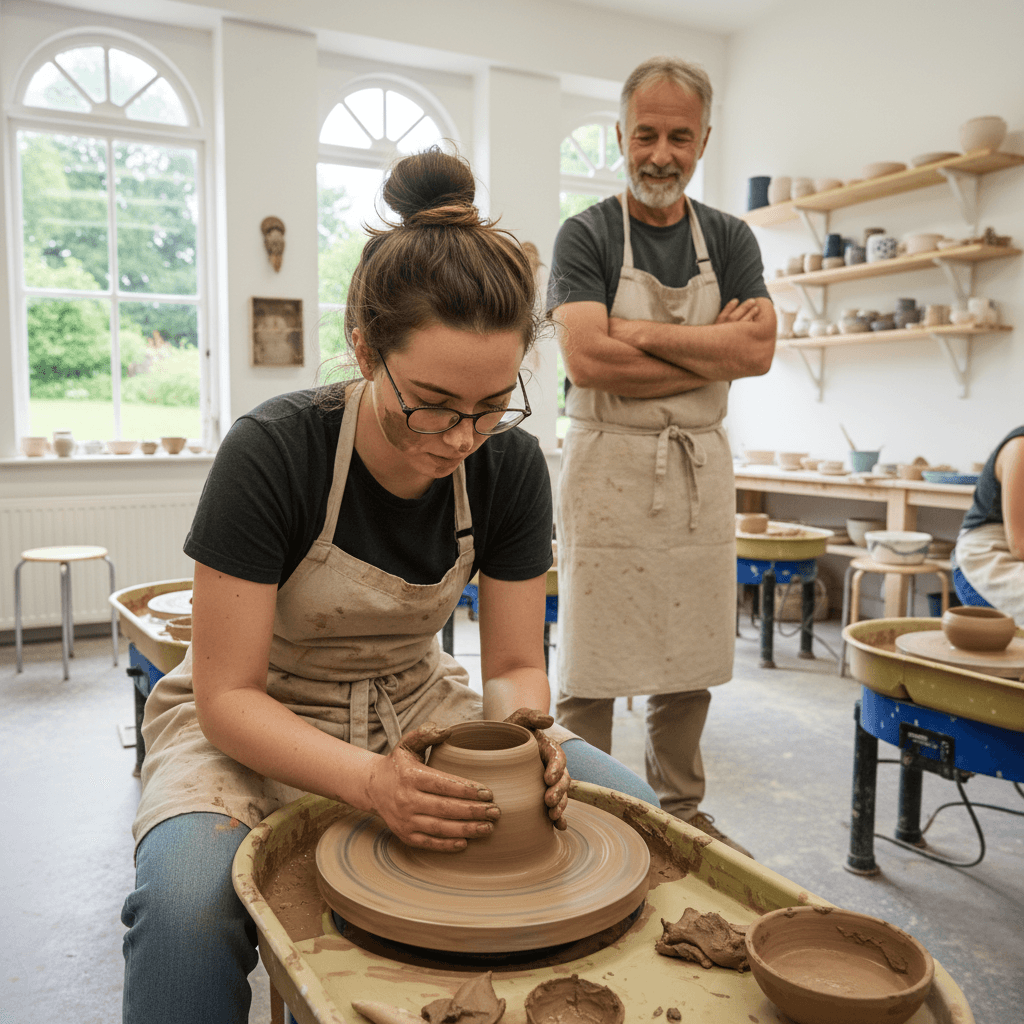
I will be honest with you. My first pottery wheel session was humbling. I watched the instructor center a lump of clay in about 10 seconds, pull up a perfect cylinder, and shape it into a bowl—smooth, even, effortless. Then I tried. The clay wobbled violently. It flew off center. My hands got tangled. Twenty minutes later I had a wonky ashtray-looking thing and clay in my hair.
If you are thinking about trying wheel throwing, here is what I wish someone had told me before that first session. Not the romanticized pottery montage version. The actual, sweaty, clay-everywhere, "why is this so hard" version.
Session 1: You will not center the clay (and that is fine)
Centering is the foundation of wheel throwing. You press the spinning clay until it sits perfectly in the middle with no wobble. Sounds simple. Is not simple.
Your instructor will tell you to "feel" when it is centered. In session 1, you will feel nothing except confused. Your clay will wobble like a drunk toddler. You will push too hard, then not hard enough. Your hands will cramp. The wheel will spray clay water everywhere.
This is completely normal. Most beginners take 3 to 5 attempts (across multiple sessions) before centering clicks. Do not measure your first session by whether you centered. Measure it by whether you enjoyed the process and want to try again.
Find wheel throwing classes with small student-to-teacher ratios. You need hands-on help to learn centering properly.
What you will actually learn in your first 6 sessions
Here is a realistic timeline based on weekly 2 hour sessions:
- Session 1: Understanding wheel speed, hand positions, and why clay goes everywhere. You might center briefly before it goes wonky again. You will make something vaguely bowl-shaped through sheer determination.
- Sessions 2-3: Centering starts making sense. You can hold it centered for longer. Opening the clay (pressing down to create the base) becomes less terrifying. You make actual cylinders, even if wobbly.
- Sessions 4-5: You can center 500g of clay consistently. Pulling up walls works sometimes. You make recognizable bowls. They are thick and uneven but functional. You feel like a potter.
- Session 6+: Throwing becomes enjoyable instead of frustrating. You understand what your hands should do. Pieces still collapse occasionally (this never stops) but you know why. You start thinking about glazes and making matching sets.
Look for pottery studios offering 6 to 8 week beginner courses. One-off taster sessions teach basics but you need repeated practice to actually develop the skill.
The centering breakthrough: how it finally clicks
Centering is not about strength. It is about alignment. Your hands and arms must work together to compress and stabilize the clay as it spins. When you get it right, the clay stops fighting you. It goes quiet. Smooth. Centered.
Most beginners try to muscle the clay. This makes it worse. The breakthrough happens when you relax, brace your arms against your body for stability, and let the wheel do the work. Apply steady pressure, not bursts of force.
Your instructor will physically guide your hands into position. Pay attention to where they place them. The exact position matters. Watch experienced potters closely—notice how their body stays still and only their hands move.
Common beginner mistakes (that I definitely made)
- Running the wheel too fast: Slow down. Beginners should work at medium speed. Fast wheels amplify mistakes and fling clay everywhere.
- Not using enough water: Clay needs constant lubrication. Dip your hands in water regularly. Dry hands create friction and destroy your piece.
- Pulling too fast: Thin the walls gradually over 3 to 4 pulls, not one aggressive yank. Patience prevents collapsing.
- Gripping too hard: Support the clay gently. Death grips create dents and wobbles. Your touch should be firm but light.
- Giving up after one session: Wheel throwing is genuinely difficult at first. Every potter struggled initially. The difference is they came back.
Essential techniques beyond centering
Once you can center, you learn these techniques in order:
- Opening: Press down into the centered clay to create a flat base. Leave about 5-10mm at the bottom (the foot). This determines your piece's width and wall thickness.
- Pulling: Squeeze the clay between your fingers and pull upward to raise and thin the walls. Start from the base, move smoothly to the rim. Repeat 3-4 times.
- Shaping: Use ribs, fingers, and sponges to refine form. Flare out for bowls, keep straight for cylinders, narrow in for vases. Compress the rim so it does not crack.
- Trimming: When leather hard (firm but not dry), flip upside down and carve away excess clay from the base. Creates a foot ring and reduces weight.
What to expect from your instructor
Good instructors demonstrate, then guide your hands. They should show the technique on their wheel, then stand behind you and physically position your hands correctly. Verbal instructions only go so far with pottery. You need to feel the right positions.
Expect instructors to stop your wheel mid-throw to correct hand placement. This is helpful, not criticism. They will also center your clay for you sometimes so you can practice pulling without the centering stress.
If you are struggling, ask for one-on-one help. Most pottery classes keep groups small (8 people max) specifically so instructors can give individual attention.
Should you practice at home?
Not yet. Home pottery wheels cost £300 to £1000+. You also need clay, tools, somewhere to store wet work, and access to a kiln. For beginners, this is unnecessary.
Instead, look for studios offering open studio sessions where you pay hourly for wheel access (£10 to £20 per hour). Once you finish a beginner course and can throw consistently, open studio time lets you practice without buying equipment.
After 6 months to a year of regular throwing, if you are still obsessed, then consider home equipment. Most potters happily use studio wheels for years before (or instead of) buying their own.
Pottery questions we’re always asked
- How long does it take to learn wheel throwing?
- Most beginners can center clay by session 5 and throw recognizable bowls by session 8 (assuming weekly 2 hour classes). Solid fundamentals take 3 to 6 months of regular practice. You feel competent making mugs and bowls after 6 months. Years of practice develop speed and the ability to throw larger or more complex forms. But you enjoy the process from day one, even while learning.
- Why is centering clay so hard?
- Centering requires coordinating multiple muscle groups while the wheel spins. Your hands, arms, and core must work together to compress and stabilize the clay. It is counterintuitive—you must apply pressure while staying relaxed. Most beginners tense up, which makes it harder. Centering clicks through repetition, not intellectual understanding. Your body learns the muscle memory after 10 to 20 attempts.
- What weight of clay should beginners use?
- Start with 500g (about 1 pound) of clay. This is enough to make a small bowl or mug but manageable for learning to center. Once you can center 500g consistently, move to 750g, then 1kg. Larger amounts are harder to center and control. Many potters work with 500g to 1kg for most functional pieces even after years of throwing.
- Why do my pots keep collapsing?
- Pots collapse when walls get too thin, too wet, or pulled up too fast. Thin walls gradually over multiple pulls rather than one aggressive pull. Keep walls even thickness (check by squeezing gently). Do not over-water the clay—it needs lubrication but too much water weakens structure. Slow down. Collapsed pots are frustrating but normal for beginners. Every potter has made hundreds of wonky collapsed pieces.
- Should I take a taster session or a full course?
- Take a 6 to 8 week beginner course if possible. Wheel throwing needs repeated practice to click. A single taster session lets you try it, but you will not learn much. Weekly sessions over 6 weeks build muscle memory and actual skills. If you are unsure whether pottery is for you, a taster works. If you want to actually learn wheel throwing, commit to a course.
- What is the best clay for beginners?
- Most studios use smooth stoneware or earthenware for beginners. These are forgiving and easy to work with. Avoid heavily grogged (gritty) clay for learning—it is harder to center and rough on hands. Trust your studio's clay choice. Once you are experienced, you can explore different clay bodies. For now, focus on technique, not materials.